Hot takes replaced analysis. Engagement replaced insight. The timeline ate the essay.
The EditorsApril 3, 20269 min readfilm-twitter, criticism, social-media
The Timeline Ate the Essay
Let’s be honest: Film Twitter is a dumpster fire. It’s a chaotic, performative arena where thoughtful criticism goes to die, trampled by a stampede of hot takes, bad-faith arguments, and engagement-baiting nonsense. What was once a promising digital water cooler for cinephiles has devolved into a toxic ecosystem that rewards the loudest, most extreme voices, not the most insightful ones. The timeline, with its relentless demand for instant reactions and 280-character verdicts, has effectively eaten the essay, leaving us with a cultural discourse that is shallow, polarized, and ultimately, boring.
This isn’t a nostalgic cry for a bygone era of print criticism. The internet democratized film discourse, and that’s a good thing. But the specific architecture of Twitter has warped the very nature of criticism, turning it from a practice of analysis and interpretation into a game of personal branding and tribal warfare. The incentive structure is broken. Engagement, not insight, is the currency. And in a world where everyone is screaming, the only way to be heard is to scream louder.
The Performance of Criticism
On Film Twitter, you’re not a critic; you’re a performer. Your takes are your act, and your followers are your audience. The goal is not to illuminate a film but to cultivate a personal brand. Are you the contrarian who hates everything popular? The stan who defends their faves with religious fervor? The political scold who sees every movie through a rigid ideological lens? Pick your character and play it to the hilt. Consistency of persona is more important than consistency of thought.
This performance is exhausting and, frankly, intellectually bankrupt. It reduces complex works of art to simple, easily digestible talking points. A film is either a “masterpiece” or “unwatchable.” There is no in-between, no room for nuance, no space for the kind of messy, contradictory reactions that great art often elicits. The algorithm rewards certainty, so everyone pretends to be certain. The result is a discourse that is as predictable as it is polarized.
Hot takes replaced analysis. Engagement replaced insight. The timeline ate the essay.
The Collapse of Nuance
The worst casualty of the Film Twitter wars is nuance. The platform’s character limit and rapid-fire pace are inherently hostile to complex thought. It’s a medium built for declarations, not discussions. nuance is a casualty of the platform’s design. You can’t unpack a film’s thematic ambiguities or analyze its formal strategies in a tweet. You can, however, declare it “problematic” or “a triumph,” and watch the likes and retweets roll in.
This has had a chilling effect on the way we talk about movies. Critics who dare to express ambivalent or complicated opinions are often accused of being wishy-washy or fence-sitters. The mob demands a verdict, a simple thumbs-up or thumbs-down. And so, the conversation flattens out, the interesting questions get ignored, and we’re left with a series of sterile, predictable debates that generate more heat than light.
The Letterboxd Crossover
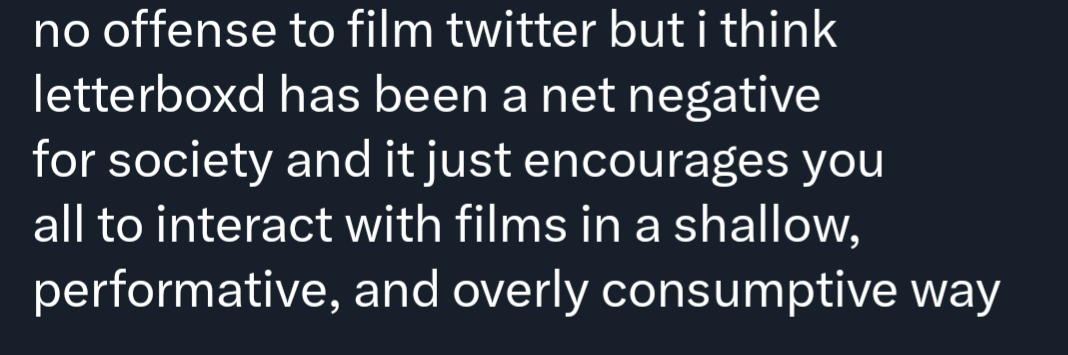
The brain-rot of Film Twitter has metastasized to other platforms, most notably Letterboxd. What was once a promising tool for cinephiles to log and review films has become another stage for the same performative nonsense. The one-liner, the meme review, the take so hot it melts your screen - these are the new currency of film criticism. Letterboxd is now just Film Twitter with a different user interface.
The problem, again, is the incentive structure. The most popular reviews on Letterboxd are often the funniest or the most outrageous, not the most insightful. The platform has gamified criticism, turning it into a competition for likes and followers. And in the process, it has further devalued the kind of thoughtful, long-form analysis that helps us make sense of what we watch.
The incentive structure is broken. Engagement, not insight, is the currency.
The bird is cooked.
The Antidote
So where do we go from here? How do we reclaim film criticism from the clutches of the timeline? The answer is simple: we need to build a better internet. We need to create and support platforms that value thoughtful analysis over hot takes, that reward nuance over noise, and that foster genuine conversation over performative outrage. We need to log off and read a book. Or a long-form essay.
This is what we’re trying to do at ummm, no. We believe that film criticism can be smart, funny, and engaging without being shallow or sensationalistic. We believe that there is still a place for long-form analysis in a world of short attention spans. And we believe that our readers are hungry for a different kind of conversation about movies, one that is more thoughtful, more nuanced, and more fun than anything you’ll find on Film Twitter.
The timeline is a dead end. It’s time to get off the hamster wheel and start talking about movies like adults again. The essay is not dead. You just have to know where to find it.
Pro Only
The Discourse
Unlock the full verdict experience. Scorecards, critic reviews, and The Discourse - all yours.